
EFWG FAQ’S
1What is the EFWG?
The Eswatini Fintech Working Group (EFWG) is a collaborative effort among regulators, policymakers, financial service providers, industry stakeholders, and other relevant parties to promote innovation, knowledge sharing, and best practices in the fintech space.
2Who can participate in the fintech working group?
Membership in the fintech working group is generally open to organizations involved in the fintech industry, including startups, financial institutions, technology providers, regulators, and policymakers.
3How can one become a partner?
To become a partner, you need to be a regulator that administers national laws, policy makers, and any other key strategic stakeholder, and be aligned with the objectives of the EFWG.
4How can I become a member?
Interested parties may contact the fintech working group directly via efwg@secretariat.co.sz.
5What are some of the benefits of being a member of the fintech working group?
Members of the fintech working group typically benefit from networking opportunities, access to industry insights, participation in policy discussions, and a platform to promote their fintech innovations.
6Are there any membership fees associated with becoming a partner or member of the EFWG?
There are no fees associated with becoming a Partner of the EFWG, except for contributions to the EFWG's collective fintech strategic objectives identified by partners.
7Will the EFWG offer funding to fintech startups?
The EFWG is not a fintech incubator and does not offer funding to startups or young innovators.
For incubation opportunities please contact the Royal Eswatini Technology Park (RSTP).
8Are crypto assets legal tender?
In short, no. According to section 23 of the Central Bank Order of 1974 "Only notes and coins which are issued by the Central Bank and which may be exchanged by the Central Bank at full value under section 26 shall be legal tender in Swaziland."
9What is EFWG official position on cryptocurrency?
EFWG policy position on crypto assets has been the wait and see approach. The Central Bank of Eswatini continues to outline and warn EmaSwati that cryptocurrencies are not legal tender in Eswatini and anyone participating in the space does so at their own risk.
10Do consumers have any recourse for losses suffered because of investing in crypto assets?
No. As explained above, crypto assets remain highly volatile and investing in crypto assets remains inherently risky. As with any investment, the ultimate responsibility to ascertain whether the risk associated with an investment lies with the consumer. As always, returns are not guaranteed, and past performance is not an indicator of future performance.
11Why are crypto asset prices so volatile?
As explained above, crypto assets do not have tried and tested valuation methods like traditional, physical assets have. Prices are therefore essentially subject to pure economic forces in the form of supply and demand or, phrased differently, the price is determined relative to what a buyer is willing to pay, and the seller is willing to accept. Given the strong retail interest in crypto assets, investor sentiment plays a significant role in determining the price of crypto assets, and accordingly contributes to the volatility.
12How does Fintech work?
Fintech works by integrating technology into offerings by financial services companies to improve their use and delivery to consumers. It primarily works by unbundling offerings by such firms and creating new markets for them. There are several types of fintech apps, and they work in different ways. One-way fintech works is by safely unlocking financial account data (e.g., transactions and account balances) with an app or service that performs an action to enhance or enrich that data. For example, wealth and financial management apps will aggregate financial account data from different accounts into one easy-to-read snapshot, showing users their entire financial picture in one place.
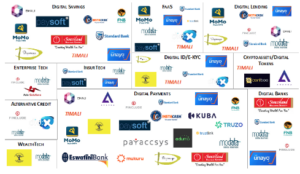
13What are some examples of Fintech in Eswatini?
14What are the benefits of Fintech?
- Increased efficiency: Fintech companies can often deliver the same solution for a lower price compared to traditional financial institutions. By leveraging technology to automate tasks, fintech companies can save money on employing people to do the work.
- Greater convenience and accessibility: Fintech companies can offer their services online or through mobile apps, making it easier for customers to access their services from anywhere.
- Improved security: Fintech companies use advanced encryption and security protocols to protect customer data and transactions.
- Financial inclusion: Fintech holds the potential to improve financial inclusion by filling the needs of the unbanked in some parts of the world where governmental or institutional support is lacking.
- Beneficial innovation and competition: FinTech’s are transforming the financial sector landscape rapidly and are blurring the boundaries of both financial firms and the financial sector. This presents a paradigm shift that has various policy implications, including fostering beneficial innovation and competition while managing risks.
15What are the risks of Fintech?
- Data breaches and cyber-attacks: Fintech companies are particularly vulnerable to data breaches and cyber-attacks because they deal with people’s money and sensitive financial data like bank accounts and personally identifiable information such as ID numbers.
- Regulatory noncompliance: Fintech companies must comply with regulations that are often complex and constantly changing. Failure to comply can result in fines, legal action, and reputational damage.
- Unforeseen market events: Unforeseen market events such inflation and increased interest rates pose a significant operational risk for fintech companies especially for developing countries such as Eswatini whose fintech’s often have limited funds.
- Personal and professional responsibility: Fintech companies work with financial services, which means they have a responsibility to ensure that their services are safe and secure for their customers.
- Global competition: Fintech is a global industry, which means that local companies must compete with other companies from developed nations, this then hinders the growth and development of Eswatini bred fintech’s who might find themselves competing with a global behemoth such as Apple pay.
16How does Fintech work?
Fintech works by integrating technology into offerings by financial services companies to improve their use and delivery to consumers. It primarily works by unbundling offerings by such firms and creating new markets for them. There are several types of fintech apps, and they work in different ways. One-way fintech works is by safely unlocking financial account data (e.g., transactions and account balances) with an app or service that performs an action to enhance or enrich that data. For example, wealth and financial management apps will aggregate financial account data from different accounts into one easy-to-read snapshot, showing users their entire financial picture in one place.
17What are some examples of Fintech in Eswatini?
18What are the benefits of Fintech?
- Increased efficiency: Fintech companies can often deliver the same solution for a lower price compared to traditional financial institutions. By leveraging technology to automate tasks, fintech companies can save money on employing people to do the work.
- Greater convenience and accessibility: Fintech companies can offer their services online or through mobile apps, making it easier for customers to access their services from anywhere.
- Improved security: Fintech companies use advanced encryption and security protocols to protect customer data and transactions.
- Financial inclusion: Fintech holds the potential to improve financial inclusion by filling the needs of the unbanked in some parts of the world where governmental or institutional support is lacking.
- Beneficial innovation and competition: FinTech’s are transforming the financial sector landscape rapidly and are blurring the boundaries of both financial firms and the financial sector. This presents a paradigm shift that has various policy implications, including fostering beneficial innovation and competition while managing risks.
19What are the risks of Fintech?
- Data breaches and cyber-attacks: Fintech companies are particularly vulnerable to data breaches and cyber-attacks because they deal with people’s money and sensitive financial data like bank accounts and personally identifiable information such as ID numbers.
- Regulatory noncompliance: Fintech companies must comply with regulations that are often complex and constantly changing. Failure to comply can result in fines, legal action, and reputational damage.
- Unforeseen market events: Unforeseen market events such inflation and increased interest rates pose a significant operational risk for fintech companies especially for developing countries such as Eswatini whose fintech’s often have limited funds.
- Personal and professional responsibility: Fintech companies work with financial services, which means they have a responsibility to ensure that their services are safe and secure for their customers.
- Global competition: Fintech is a global industry, which means that local companies must compete with other companies from developed nations, this then hinders the growth and development of Eswatini bred fintech’s who might find themselves competing with a global behemoth such as Apple pay.
FAQ’S Crypto Assets
1What is a crypto asset?
Crypto assets are digital assets that use cryptography, peer-to-peer networking, and a public ledger to create, verify, and secure transactions without a middleman. They can be transferred, stored, or traded electronically for other crypto assets, fiat currency, or goods and services. Crypto assets can also be tokenized, which means transferring the value of an object to a blockchain. They are not considered legal tender or regulated in Eswatini.
2How many crypto assets are there?
As of November 2021, there are more than 7,800 crypto assets available for consumers to choose from1. However, the number of cryptocurrencies is constantly changing and can be difficult to track. According to Statista, there were nearly 9,000 cryptocurrencies as of 2023.
3Are crypto assets legal tender?
In short, no. According to section 23 of the Central Bank Order of 1974 "Only notes and coins which are issued by the Central Bank and which may be exchanged by the Central Bank at full value under section 26 shall be legal tender in Swaziland."
4What is EFWG official position on cryptocurrency?
EFWG policy position on crypto assets has been the wait and see approach. The Central Bank of Eswatini continues to outline and warn EmaSwati that cryptocurrencies are not legal tender in Eswatini and anyone participating in the space does so at their own risk.
5Do consumers have any recourse for losses suffered because of investing in crypto assets?
No. As explained above, crypto assets remain highly volatile and investing in crypto assets remains inherently risky. As with any investment, the ultimate responsibility to ascertain whether the risk associated with an investment lies with the consumer. As always, returns are not guaranteed, and past performance is not an indicator of future performance.
6Why are crypto asset prices so volatile?
As explained above, crypto assets do not have tried and tested valuation methods like traditional, physical assets have. Prices are therefore essentially subject to pure economic forces in the form of supply and demand or, phrased differently, the price is determined relative to what a buyer is willing to pay, and the seller is willing to accept. Given the strong retail interest in crypto assets, investor sentiment plays a significant role in determining the price of crypto assets, and accordingly contributes to the volatility.
FAQ’S Fintech
1What is Financial Technology (Fintech)?
The Financial Stability Board (FSB) defines FinTech as technologically enabled innovation in financial services that could result in new business models, applications, processes or products with an associated material effect on financial markets and institutions and the provision of financial services.
2How does Fintech work?
Fintech works by integrating technology into offerings by financial services companies to improve their use and delivery to consumers. It primarily works by unbundling offerings by such firms and creating new markets for them. There are several types of fintech apps, and they work in different ways. One-way fintech works is by safely unlocking financial account data (e.g., transactions and account balances) with an app or service that performs an action to enhance or enrich that data. For example, wealth and financial management apps will aggregate financial account data from different accounts into one easy-to-read snapshot, showing users their entire financial picture in one place.
3What are some examples of Fintech in Eswatini?
4What are the benefits of Fintech?
- Increased efficiency: Fintech companies can often deliver the same solution for a lower price compared to traditional financial institutions. By leveraging technology to automate tasks, fintech companies can save money on employing people to do the work.
- Greater convenience and accessibility: Fintech companies can offer their services online or through mobile apps, making it easier for customers to access their services from anywhere.
- Improved security: Fintech companies use advanced encryption and security protocols to protect customer data and transactions.
- Financial inclusion: Fintech holds the potential to improve financial inclusion by filling the needs of the unbanked in some parts of the world where governmental or institutional support is lacking.
- Beneficial innovation and competition: FinTech’s are transforming the financial sector landscape rapidly and are blurring the boundaries of both financial firms and the financial sector. This presents a paradigm shift that has various policy implications, including fostering beneficial innovation and competition while managing risks.
5What are the risks of Fintech?
- Data breaches and cyber-attacks: Fintech companies are particularly vulnerable to data breaches and cyber-attacks because they deal with people’s money and sensitive financial data like bank accounts and personally identifiable information such as ID numbers.
- Regulatory noncompliance: Fintech companies must comply with regulations that are often complex and constantly changing. Failure to comply can result in fines, legal action, and reputational damage.
- Unforeseen market events: Unforeseen market events such inflation and increased interest rates pose a significant operational risk for fintech companies especially for developing countries such as Eswatini whose fintech’s often have limited funds.
- Personal and professional responsibility: Fintech companies work with financial services, which means they have a responsibility to ensure that their services are safe and secure for their customers.
- Global competition: Fintech is a global industry, which means that local companies must compete with other companies from developed nations, this then hinders the growth and development of Eswatini bred fintech’s who might find themselves competing with a global behemoth such as Apple pay.